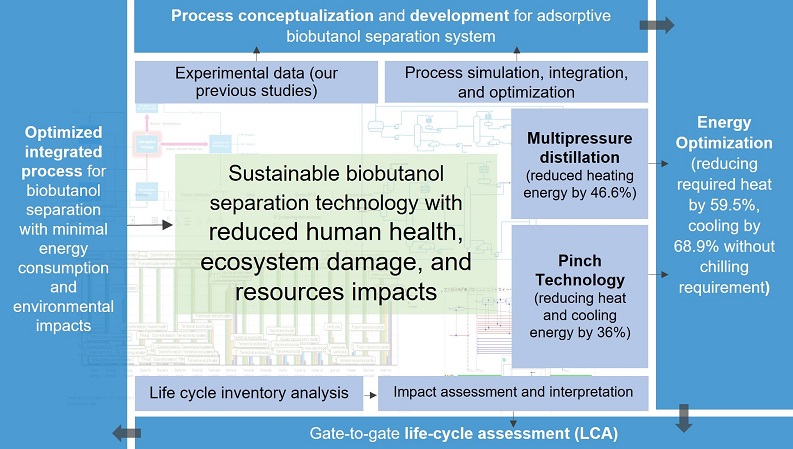
Biobutanol stands out as an advanced renewable biofuel, yet its production through fermentation yields a low butanol concentration, necessitating expensive and energy-intensive separation methods, particularly by distillation. Alternative approaches, including adsorptive separation, have emerged, with the 2-column zeolite-based process showing promise. This study employed Aspen Plus for simulating adsorptive separation, utilized Pinch technology for heat integration, and analyzed various alternatives using the life cycle assessment (LCA) approach. Compared to the base case, which relied on our previously acquired experimental data and further purification through atmospheric distillation, the adoption of indirect heating/cooling adsorption reduced heating energy demand by 59.5%. Additionally, cooling energy usage was increased notably by 68.9%, and chilling prerequisites were eliminated. The implementation of Pinch technology further reduced heating and cooling energy requirements by approximately 36%. Multi-pressure distillation was also explored, revealing its potential to reduce heating energy consumption by 46.6%, accompanied by a modest 6.2% increase in cooling energy demand. A gate-to-gate LCA framework was used to evaluate the environmental impacts. The results showed that the combination of indirect heating/cooling adsorption, multi-pressure distillation, and energy-efficient practices resulted in over a 98% reduction in damages related to human health, ecosystem well-being, and resource depletion compared to the base case. Prioritization of key performance indicators revealed that human health had the most significant influence, with prominent midpoint effects attributed to human toxicity and global warming. This study underscores the pivotal role of energy targeting in curtailing energy consumption and enhancing the sustainability of adsorptive biobutanol separation.
Graphical Abstract
Highlights
Adsorptive ABE separation coupled with distillation is highly energy intensive.
Pinch technology can reduce heating and cooling energy by about 36%.
Pumping energy is ignorable compared to those for adsorption and distillation.
Employing multi-pressure distillation is critical for efficient energy saving.
Over 98% decline in human health, ecosystem, and resource damage can be obtained.
ISO, I., 2006. ISO 14040 International Standard. Environmental Management-Life Cycle Assessment-Principles and Framework, 2006. Int Organ Stand Geneva, Switzerland.
International Organization for Standardization, 2006. Environmental management: life cycle assessment; requirements and guidelines. Geneva, Switzerland: ISO. 14044
Karimi,K. , Khoshnevisan,B. and Denayer,J. F.M. (2024). Critical impacts of energy targeting on the sustainability of advanced biobutanol separation. Biofuel Research Journal, 11(1), 1999-2012. doi: 10.18331/BRJ2024.11.1.2
MLA
Karimi,K. , , Khoshnevisan,B. , and Denayer,J. F.M.. "Critical impacts of energy targeting on the sustainability of advanced biobutanol separation", Biofuel Research Journal, 11, 1, 2024, 1999-2012. doi: 10.18331/BRJ2024.11.1.2
HARVARD
Karimi K., Khoshnevisan B., Denayer J. F.M. (2024). 'Critical impacts of energy targeting on the sustainability of advanced biobutanol separation', Biofuel Research Journal, 11(1), pp. 1999-2012. doi: 10.18331/BRJ2024.11.1.2
CHICAGO
K. Karimi, B. Khoshnevisan and J. F.M. Denayer, "Critical impacts of energy targeting on the sustainability of advanced biobutanol separation," Biofuel Research Journal, 11 1 (2024): 1999-2012, doi: 10.18331/BRJ2024.11.1.2
VANCOUVER
Karimi K., Khoshnevisan B., Denayer J. F.M. Critical impacts of energy targeting on the sustainability of advanced biobutanol separation. BRJ, 2024; 11(1): 1999-2012. doi: 10.18331/BRJ2024.11.1.2