Document Type : Review Paper
Authors
1
State Key Laboratory of Heavy Oil Processing, Beijing Key Laboratory of Biogas Upgrading Utilization, College of New Energy and Materials, China University of Petroleum Beijing (CUPB), Beijing 102249, China.
2
Shandong Institute of Petroleum and Chemical Technology, Carbon Neutrality Research Institute, Dongying 257061, China.
3
NIBIO, Norwegian Institute of Bioeconomy Research, P.O. Box 115, N-1431 Ås, Norway.
4
Qingdao Institute of Bioenergy and Bioprocess Technology, Chinese Academy of Sciences, NO. 189 Songling Road, Qingdao 266101, China.
5
State Key Laboratory of Efficient Utilization of Arid and Semi-arid Arable Land in Northern China, Institute of Agricultural Resources and Regional Planning, Chinese Academy of Agricultural Sciences, Beijing 100081, China.
Abstract
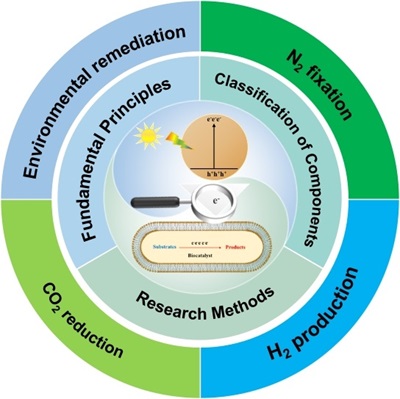
Creatively integrating synthetic materials (semiconductors and electrodes) and microorganisms, the semi-artificial photosynthetic system (SAPS) couples the advantages of natural photosystems (high catalytic reaction selectivity) and artificial photosystems (excellent light-harvesting performance). This combination effectively overcomes the shortcomings of poor selectivity in artificial photosystems, bringing new opportunities for developing photosynthetic systems. It also provides a promising strategy for addressing the current energy crisis and environmental pollution. The design and selection of synthetic materials play a crucial role in this system, aiming to achieve efficient photon capture and electron transfer. This review begins by exploring the fundamental principles of SAPS, emphasizing the integration of materials and microorganisms and the factors that influence their interactions. It provides a critical analysis of the diverse compositional arrangements and systematically elucidates the foundational research methodologies employed in the investigation of SAPS. Grounded in their distinctive redox characteristics, it comprehensively surveys their recent applications in environmental remediation and sustainable energy production over the past years. Finally, reflections on future research are proposed, beginning with the challenges that limit the application of SAPS. Building on previous studies, the present review identifies the factors that limit SAPS and suggests potential avenues for future research. Additionally, this review delves into the environmental and economic policies and practical implications. In conclusion, by critically assessing the existing research landscape, delineating challenges, and charting future research directions, the present review aims to provide valuable insights for researchers and practitioners, guiding efforts toward advancing SAPS for enhanced environmental sustainability and economic feasibility.
Graphical Abstract
Highlights
- Semi-artificial photosynthetic systems (SAPS) enhance photosynthesis efficiency by synthetic-microorganism integration.
- Combining natural selectivity, SAPS offers superior light harvesting capability.
- SAPS can be used for environmental remediation and renewable energy generation.
- Synthetic materials play a crucial role in photon capture and transfer in SAPS.
Keywords