Document Type : Research Paper
Authors
1
Department of Environmental Science and Engineering, School of Engineering and Sciences, SRM University – AP, Andhra Pradesh, 522502, India.
2
Department of Chemical Engineering, SUNY College of Environmental Science and Forestry, Syracuse, NY, 13210, USA.
3
NIRT Renewable Energy Private Limited, Salem, Tamil Nadu, 636004, India.
4
The NET ZERO Lab, Department of Environmental Science and Engineering, School of Engineering and Sciences, SRM University – AP, Andhra Pradesh, 522502, India.
Abstract
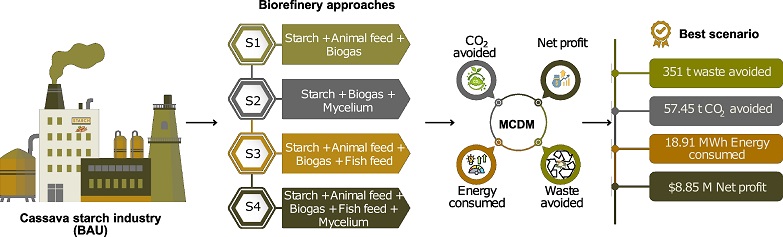
Cassava, a staple food crop, is widely used for starch production, but its inconsistent supply, price volatility, and substantial waste generation pose challenges to the cassava industrial market's growth. This study aims to identify a sustainable biorefinery pathway by optimizing conventional cassava starch plants (business-as-usual, BAU) for economic and environmental benefits. Four scenarios were evaluated: animal feed from peel waste (Scenario 1), fungal protein from thippi waste (Scenario 2), fish feed from digested wastewater (Scenario 3), and conversion of all waste streams into animal feed, fish feed, and fungal protein (Scenario 4). Scenario 4 emerged as the best pathway using the multi-criteria decision-making (MCDM) approach, with a performance score of 0.282. Despite the highest energy consumption (18.91 MWh), Scenario 4 was favored for producing four value-added products alongside starch, yielding the highest profit at USD 8.85 million. In contrast, profits for BAU, Scenario 1, Scenario 2, and Scenario 3 were 1.91, 2.30, 5.01, and USD 8.79 million, respectively. Waste valorization in Scenarios 1, 2, 3, and 4 resulted in CO2 avoidance of 36.5., 42.6., 21.7, and 57.45 t CO2eq., respectively. However, producing value-added products increased energy consumption by 13, 73, 7, and 74% compared to BAU (4.58 MWh). The global warming potential analysis showed negative values for scenarios 2 and 4, at -436 and -434 kg CO2eq./t root, respectively. This study highlights the potential of a biorefinery approach for sustainable cassava starch production, providing insights for future research and policy development.
Graphical Abstract
Highlights
- Cassava starch plant uses 4.58 MWh to process 75 t of cassava root.
- Best biorefinery was identified using decision-making on energy, profit, emission, and waste.
- Global warming potential of the best biorefinery scenario was -434 kg CO2eq./t root.
- Best biorefinery scenario led to 18.91 MWh, USD8.85 M profit, 350 t waste avoided, and 57.45 t CO2 avoided.
Keywords