Biofuel Research Journal

Biofuel Research Journal

Sustainable biokerosene from lipids using efficient ozone cracking

Document Type : Research Paper

Authors
1 Department of Agricultural and Biological Engineering, Purdue University, West Lafayette, IN 47907, United States.
2 Laboratory of Renewable Resources Engineering, Purdue University, West Lafayette, IN 47907, United States.
Abstract
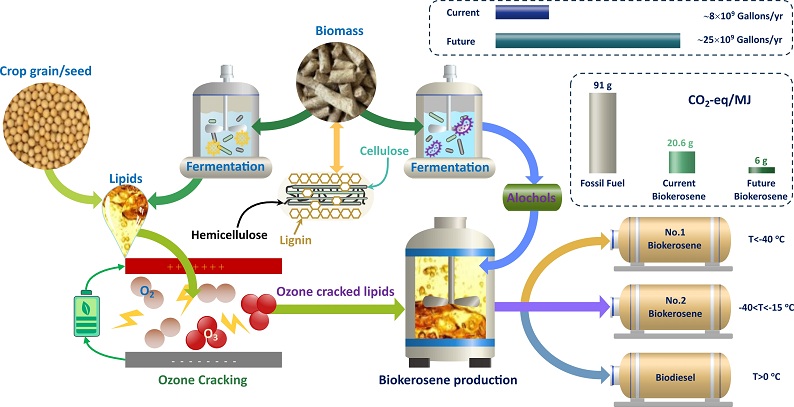
Diesel fuels and jet fuels will dominate the future liquid fuel market. Biodiesel, renewable diesel, and sustainable aviation fuel are alternatives for carbon sequestration in the transportation sector. However, biodiesel and renewable diesel are unsuitable for use during cold winter seasons or as jet fuel. Moreover, renewable diesel and sustainable aviation fuel face challenges such as harsh operating conditions and high energy consumption. A groundbreaking production process was investigated to synthesize biokerosene using nonanoic acid, a major compound from lipid ozone cracking. Various alcohols can be used to tune the physicochemical properties of biokerosene. The synthesized biokerosene exhibited excellent low-temperature performance, characterized by cloud points ranging from −35 to −67 °C, making it suitable for winter-season diesel, kerosene, and jet fuels. In addition, the products showed several superior qualities, such as long oxidation stability for extended storage, high flash points for safe handling, and high cetane numbers. Emission analysis indicated that the presence of oxygen in the fuel molecules facilitates combustion and reduces hydrocarbon and CO emissions. Moreover, nitrogen oxide emissions, associated with a global warming potential about 300 times that of CO₂, were significantly lower than those of biodiesel and jet fuel. Preliminary techno-economic analysis showed that the production cost of biokerosene was approximately USD 0.97/kg. Preliminary life cycle assessment showed CO₂ emissions of about 20.6 g CO₂-eq/MJ, representing a 77% reduction in greenhouse gas emissions. These emissions can be further reduced to about 6 g CO₂-eq/MJ with clean electricity and low-carbon alcohol. In summary, the biokerosene synthesis presented in this study offers a sustainable and economical route for producing winter-season diesel and jet fuel.

Graphical Abstract

Sustainable biokerosene from lipids using efficient ozone cracking

Highlights

  • Biokerosene is suitable for environments with temperatures as low as -67 oC.
  • Yields of biokerosene (No. 1 and No.2) can reach approximately 1.3 kg/kg oil.
  • Emission analysis showed that biokerosene can reduce NOx emissions by up to 40%.
  • Biokerosene use can reduce CO2 emissions by over 93%.
  • The annual biokerosene production in the U.S. could reach 25 BGal.

Keywords

  1. ASTM D 7566, 2022. Standard specification for aviation turbine fuel containing synthesized hydrocarbons. ASTM International.
  2. ASTM D 975, 2022. Standard specification for aviation turbine fuel containing synthesized hydrocarbons. ASTM International.
  3. ASTM D 6751, 2023. Standard specification for biodiesel fuel blend stock (B100) for middle distillate Fuels. ASTM International.
  4. Bain, R.L., Magrini-Bair, K.A., Hensley, J.E., Jablonski, W.S., Smith, K.M., Gaston, K.R., Yung, M.M., 2014. Pilot scale production of mixed alcohols from wood. Ind. Eng. Chem. Res. 53(6), 2204-2218.
  5. Baliban, R.C., Elia, J.A., Floudas, C.A., Xiao, X., Zhang, Z., Li, J., Cao, H., Ma, J., Qiao, Y., Hu, X., 2013. Thermochemical conversion of duckweed biomass to gasoline, diesel, and jet fuel: process synthesis and global optimization. Ind. Eng. Chem. Res. 52(33), 11436-11450.
  6. com, 2025a. Sodium hydroxide price index.
  7. com, 2025b. Sulfuric acid price index.
  8. Chong, C.T., Ng, J.H., 2021.Vhapter- Biojet fuel production pathways, in: biojet fuel in aviation applications. Elsevier, pp. 81-141.
  9. Costa do Nascimento, D., Dorighello Carareto, N.D., Marinho Barbosa Neto, A., Gerbaud, V., da Costa, M.C., 2020. Flash point prediction with UNIFAC type models of ethylic biodiesel and binary/ternary mixtures of FAEEs. Fuel. 281, 118717.
  10. Dagdougui, H., Sacile, R., Bersani, C., Ouammi, A., 2018. Chapter2-hydrogen production and current technologies, in: Hydrogen infrastructure for energy applications. Elsevier, pp. 7-21.
  11. Davis, R., Tao, L., Scarlata, C., E.C.D., T., Ross, J., Lukas, J., Sexton, D., 2015. Process design and economics for the conversion of lignocellulosic biomass to hydrocarbons: dilute-acid and enzymatic deconstruction of biomass to sugars and catalytic conversion of sugars to hydrocarbons, National Renewable Energy Laboratory.
  12. De Jong, S., Antonissen, K., Hoefnagels, R., Lonza, L., Wang, M., Faaij, A., Junginger, M., 2017. Life-cycle analysis of greenhouse gas emissions from renewable jet fuel production. Biotechnol. Biofuels. 10(1), 64.
  13. De Jong, S., Hoefnagels, R., Faaij, A., Slade, R., Mawhood, R., Junginger, M., 2014. The feasibility of short-term production strategies for renewable jet fuels-a comprehensive techno-economic comparison. Biofuels Bioprod. Biorefin. 8(6), 743.
  14. Diederichs, G.W., Ali Mandegari, M., Farzad, S., Görgens, J.F., 2016. Techno-economic comparison of biojet fuel production from lignocellulose, vegetable oil and sugar cane juice. Bioresour. Technol. 216, 331-339.
  15. Dowe, N., 2019. DOE Bioenergy Technologies Office (BETO) 2019 Project Peer Review.
  16. Fakayode, O.A., Akpabli-Tsigbe, N.D.K., Wahia, H., Tu, S., Ren, M., Zhou, C., Ma, H., 2021. Integrated bioprocess for bio-ethanol production from watermelon rind biomass: ultrasound-assisted deep eutectic solvent pretreatment, enzymatic hydrolysis and fermentation. Renewable Energy. 180, 258-270.
  17. Ha, J.W., Liu, J., Feng, H., Sahinidis, N. V., Seo, H., Siirola, J.J., Na, J., 2024. Ultrasound-based separation of ethanol-water mixtures is economically advantageous and sustainable. Cell. Rep. Phys. Sci. 5(2), 101785.
  18. Han, J., Tao, L., Wang, M., 2017. Well-to-wake analysis of ethanol-to-jet and sugar-to-jet pathways. Biotechnol. Biofuels. Bioprod. 10(1).
  19. Hassan, Z., 2023. An overview of the development of high oleic soybean oil in the United States and its implication on palm oil.
  20. IEA, 2021. Global hydrogen review 2021, OECD Publishing.
  21. IEA, 2023. Comparison of the emissions intensity of different hydrogen production routes.
  22. Jafarihaghighi, F., Ardjmand, M., Salar Hassani, M., Mirzajanzadeh, M., Bahrami, H., 2020. Effect of fatty acid profiles and molecular structures of nine new source of biodiesel on combustion and emission. ACS Omega. 5(26), 16053-16063.
  23. Jodzis, S., Zięba, M., 2018. Energy efficiency of an ozone generation process in oxygen. Analysis of a pulsed DBD system. Vacuum. 155, 29-37.
  24. Kourkoumpas, D., Sagani, A., Hull, A., Hull, A., Karellas, S., Grammelis, P., 2024. Life cycle assessment of an innovative alcohol-to-jet process: the case for retrofitting a bioethanol plant for sustainable aviation fuel production. Renewable Energy. 228.
  25. Kruger, J.S., Cleveland, N.S., Yeap, R.Y., Dong, T., Ramirez, K.J., Nagle, N.J., Lowell, A.C., Beckham, G.T., McMillan, J.D., Biddy, M.J., 2018. Recovery of fuel-precursor lipids from oleaginous yeast. ACS Sustainable Chem. Eng. 6(3), 2921-2931.
  26. Liu, J., Beckerman, J., 2022. Application of sustainable biosorbents from hemp for remediation of copper(II)-containing wastewater. J. Environ. Chem. Eng. 10(3), 107494.
  27. Liu, J., Feng, H., 2024. Experimental and theoretical analysis of ultrasonic separation in bioethanol purification. Results in Eng. 24, 102886.
  28. Liu, J., Pearlstein, A.J., Feng, H., 2025. Effects of operating parameters on single-stage ultrasonic separation of ethanol from its aqueous solutions. Sep. Purif. Technol. 353(Part A), 128179.
  29. Liu, J., Tao, B., 2022a. Thermodynamically predicting liquid/solid phase change of long-chain fatty acid methyl esters (FAMEs) and its application in evaluating the low-temperature performance of biodiesel. J. Taiwan. Inst. Chem. Eng. 135, 104384.
  30. Liu, J., Tao, B., 2022b. Fractionation of fatty acid methyl esters via urea inclusion and its application to improve the low-temperature performance of biodiesel. Biofuel Res. J. 9(2), 1617-1629.
  31. Liu, J., Pearstein, A.J., Feng, H., 2023a. Ultrasonic separation in bioethanol refining. Chem. Eng. Prog. 119(3), 24-30.
  32. Liu, J., Tao, B.Y., Feng, H., Mosier, N.S., 2023b. Efficient rapid fractionation of fatty acid methyl esters (FAMEs) through evaporative urea inclusion. Chem. Eng. J. 454(Part 3), 140266.
  33. Liu, J., Zhang, C., Tao, B., Beckerman, J., 2023c. Revealing the roles of biomass components in the biosorption of heavy metals in wastewater by various chemically treated hemp stalks. J. Taiwan. Inst. Chem. Eng. 143, 104701.
  34. Mailaram, S., Maity, S.K., 2022. Dual liquid–liquid extraction versus distillation for the production of bio-butanol from corn, sugarcane, and lignocellulose biomass: a techno-economic analysis using pinch technology. Fuel. 312, 122932.
  35. Malins, K., 2021. Synthesis of renewable hydrocarbons from vegetable oil feedstock by hydrotreatment over selective sulfur-free SiO2-Al2O3 supported monometallic Pd, Pt, Ru, Ni, Mo and bimetallic NiMo catalysts. Fuel. 285, 119129.
  36. Matlock, M.G., 2022. Introduction: the need for high-oleic oils, High Oleic Oils. Elsevier Inc.
  37. Matthew, W., Ryan, D., Jake, K., 2022. Algal biomass conversion to fuels via combined algae processing (CAP): 2021 state of technology and future research. Golden, CO. National Renewable Energy Laboratory. NREL/TP-5100-82502.
  38. McCormick, M.S.G. and R.L., Colorado, 1998. Combustion of fat and vegetable oil derived fuels in diesel engines. Prog. Energy Combust. Sci. 24(97), 125-164.
  39. Nagapurkar, P., Smith, J.D., 2023. Techno-economic and life cycle analyses for a supercritical biodiesel production process from waste cooking oil for a plant located in the Midwest United States. Dev. Sustainable. 1-25.
  40. Naidu, H., Liu, J., Kahraman, O., Feng, H., 2021. Ultrasound-assisted nonthermal, nonequilibrium separation of organic molecules from their binary aqueous solutions: effect of solute properties on separation. ACS Sustainable Chem. Eng. 9(48), 16506-16518.
  41. Nogales-Delgado, S., Encinar, J.M., González Cortés, Á., 2021. High oleic safflower oil as a feedstock for stable biodiesel and biolubricant production. Ind. Crops. Prod. 170, 113701.
  42. Nowatzki, J., Shrestha, D., Swenson, A., Wiesenborn, D., 2019. Biodiesel cloud point and cold weather issues.
  43. Orjuela, A., Paulo, C., Cadavid, J.G., García-nunez, J.A., 2022. Experimental optimization during epoxidation of a high-oleic palm oil using a simplex algorithm. Ind. Crops Prod. 187(Part A), 115321.
  44. Ou, Y., West, J.J., Smith, S.J., Nolte, C.G., Loughlin, D.H., 2020. Air pollution control strategies directly limiting national health damages in the US. Commun. 11(1), 957.
  45. Santos, S.M., Nascimento, D.C., Costa, M.C., Neto, A.M.B., Fregolente, L. V., 2020. Flash point prediction: reviewing empirical models for hydrocarbons, petroleum fraction, biodiesel, and blends. Fuel. 263, 116375.
  46. Scully, M.J., Norris, G.A., Alarcon Falconi, T.M., MacIntosh, D.L., 2021. Carbon intensity of corn ethanol in the United States: state of the science. Environ. Res. Lett. 16.
  47. Seay, S., 2024. Sustainable biomass production capacity could triple US bioeconomy.
  48. Shin, J., Kim, D., Seo, J., Park, S., 2020. Effects of the physical properties of fuel on spray characteristics from a gas turbine nozzle. Energy. 205, 118090.
  49. Smith, C.J., Forster, P.M., Allen, M., Fuglestvedt, J., Millar, R.J., Rogelj, J., Zickfeld, K., 2019. Current fossil fuel infrastructure does not yet commit us to 1.5 °C warming. Nat Commun 10(1), 101.
  50. Tat, M.E., Van Gerpen, J.H., 1999. The kinematic viscosity of biodiesel and its blends with diesel fuel. JAOCS, J. Am. Oil Chem. Soc. 76(12), 1511-1513.
  51. TGSC, The good scents company information system.
  52. Trading Economics, 2025. Naphtha.
  53. S. EIA, 2023. Monthly energy review, monthly energy review.
  54. S. EIA, 2024a. Carbon dioxide emission coefficients.
  55. S. EIA, 2024b. How much carbon dioxide is produced per kilowatthour of U.S. electricity generation?
  56. S. EIA, 2025a. Electric power monthly.
  57. S. EIA, 2025b. Indiana natural gas industrial price.
  58. S. EIA, 2025c. Weekly Indiana propane residential price.
  59. USDA AMS, 2025. National weekly ethanol report.
  60. Voeten, R.L.C., Hendriks, F., Bezemer, G.L., 2024. Fischer-tropsch synthesis for the production of sustainable aviation fuel: formation of tertiary amines from ammonia contaminants. ACS Omega. 9 (29), 31974-31985.
  61. Walkling, C.J., Doppalapudi, K.R., Zhang, D.D., Harvey, B.G., 2025. Renewable diesel fuel prepared by the isomerization and hydrogenation of biosynthetic farnesene. Energy Fuels. 39(18), 8495-8500.
  62. Wang, W.-C., Tao, L., Markham, J., Zhang, Y., Tan, E., Batan, L., Biddy, M., Wang, W.-C., Tao, L., Zhang, Y., Tan, E., Warner, E., Biddy, M., 2016. Review of biojet fuel conversion technologies. Golden, CO. National Renewable Energy Lab. NREL/TP-5100-66291.
  63. Wei, H., Liu, W., Chen, X., Yang, Q., Li, J., Chen, H., 2019. Renewable bio-jet fuel production for aviation: a review. Fuel. 254, 115599.
  64. Williams, L., Emerson, R., Tumulura, J.S., 2017. Biomass compositional analysis for conversion to renewable fuels and chemicals, in: Biomass volume estimation and valorization for energy.
  65. Xu, H., Lee, U., Wang, M., 2020. Life-cycle energy use and greenhouse gas emissions of palm fatty acid distillate derived renewable diesel. Renew. Sust. Energy Rev. 134, 110144.
  66. Xu, H., Ou, L., Li, Y., Hawkins, T.R., Wang, M., 2022. Life cycle greenhouse gas emissions of biodiesel and renewable diesel production in the United States. Sci. Technol. 56(12), 7512-7521.
  67. Xue, C., Cheng, C., 2019. Chapter Two-Butanol production by 1st ed, Advances in bioenergy. Elsevier Inc.
  68. Zoppi, G., Tito, E., Bianco, I., Pipitone, G., Pirone, R., Bensaid, S., 2023. Life cycle assessment of the biofuel production from lignocellulosic biomass in a hydrothermal liquefaction-aqueous phase reforming integrated biorefinery. Renewable Energy. 206, 375-385.