Document Type : Review Paper
Authors
1
Research Institute of Integrative Life Sciences, Dongguk University-Seoul, Ilsandong-gu, Goyang-si, Gyeonggido, 10326, Republic of Korea.
2
Department of Biological and Environmental Science, Dongguk University, Ilsandong-gu, Goyang-si, Gyonggido, 10326, Republic of Korea.
3
Department of Environmental Microbiology (DEM), Babasaheb Bhimrao Ambedkar University, Vidya Vihar, Raebareli Road, Lucknow-226 025 (U.P.), India.
4
Institute of Aquatic Science and Technology, National Kaohsiung University of Science and Technology, Kaohsiung City, Taiwan.
5
Centre for Energy and Environment, Malaviya National Institute of Technology, Jaipur 302017, India.
6
Department of Biological Engineering, College of Engineering, Konkuk University, Seoul 05029, Republic of Korea.
7
Graduate Program in Genomic Sciences and Biotechnology, Catholic University of Brasília, Brasília, 71966-700, Brazil.
8
Department of Food Science and Biotechnology, Dongguk University-Seoul, Ilsandong-gu, Goyang-si, Gyeonggido, 10326, Republic of Korea.
9
College of Natural Resources and Environment, Northwest A&F University, Yangling, Shaanxi Province, 712100, China.
10
School of Chemical Engineering, KIIT Deemed to be University, Bhubaneswar, Odisha 751024, India.
11
Department of Earth Resources & Environmental Engineering, Hanyang University, Seoul 04763, Republic of Korea.
Abstract
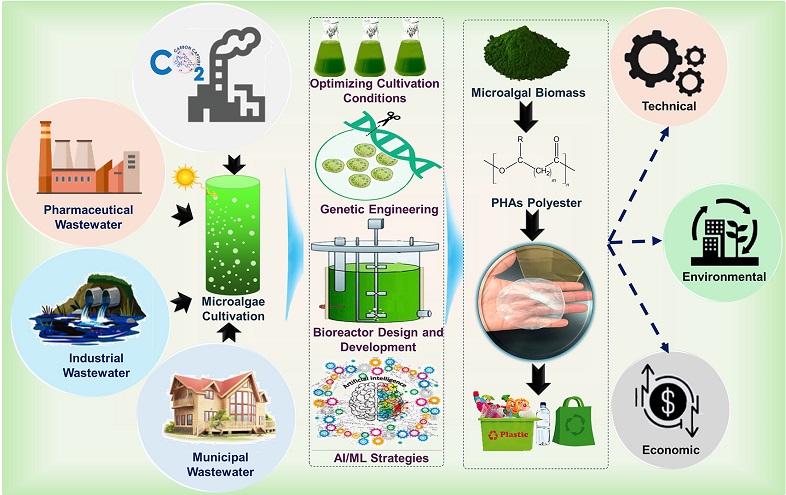
Bio-based plastics, primarily polyhydroxyalkanoates (PHAs), offer a hopeful alternative to petroleum-derived plastics. Third-generation (3G; microalgae/cyanobacteria) biomass has gained significant importance due to its rapid biomass productivity and metabolic versatility. Microalgae can produce PHAs by utilizing CO2 and wastewater, establishing them as highly promising and eco-friendly systems for bioplastic production. This comprehensive review presents comprehensive insights into microalgae-PHA production, from optimization of physicochemical and cultural conditions to effective PHA purification processes. The critical review also examines the latest advancements in cultivation strategies, metabolic engineering, and bioreactor developments, which may lead to more sustainable and progressive microalgal-based bioplastic accumulation. The effectiveness of algae biomass generation for PHA accumulation through integrated wastewater treatment has been addressed. This review examines the role of mathematical modeling and emerging artificial intelligence in advancing algae-based PHA production processes. Finally, the review concludes with a discussion of the economic and social challenges, life cycle analysis, and prospects for research and development of advanced microalgal-derived bioplastics production and predictions of potential solutions for economically feasible and sustainable microalgae-based PHA production at the industrial scale.
Graphical Abstract
Highlights
- Polyhydroxyalkanoates (PHAs) represent sustainable, valuable, and biodegradable plastics.
- This research suggests aspects of third-generation biomass resources (microalgae) for bioplastic synthesis.
- Integrating wastewater treatment with carbon capture presents a promising approach to PHA production.
- Nutrient regimes, genetic manipulation, and bioreactor design are crucial for advancing PHA production.
- The role of advanced artificial intelligence and machine learning in microalgae PHA production is discussed.
Keywords